
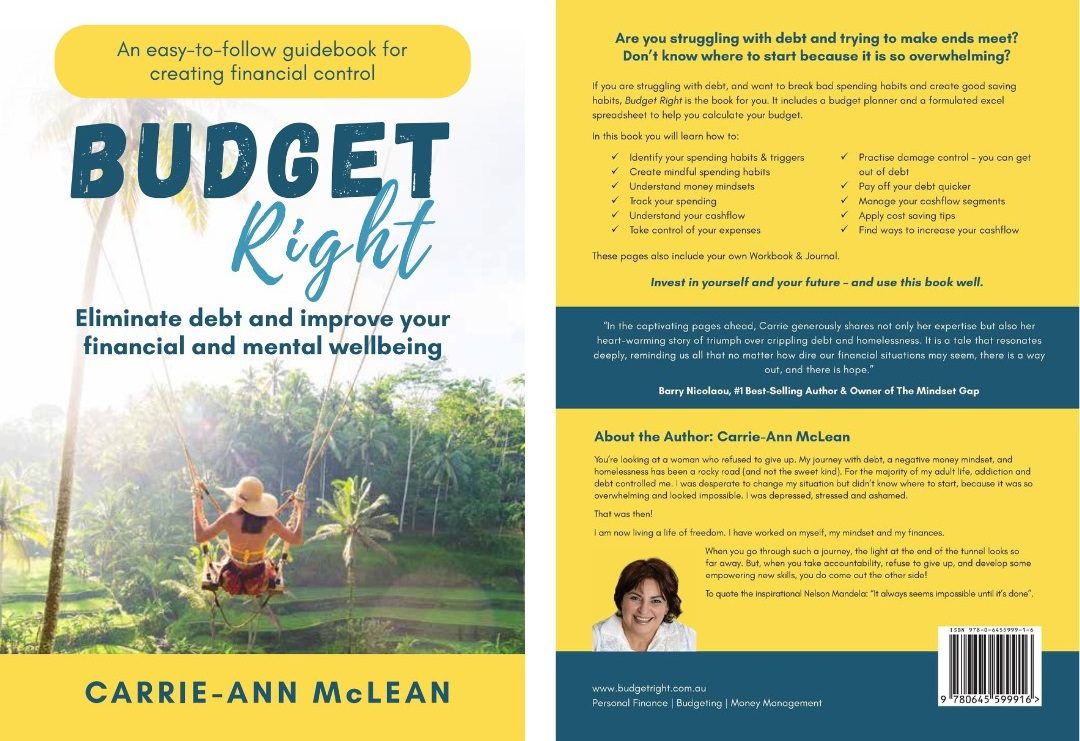
Why This Book Needed to Exist
Many budgeting books teach structure, formulas and savings strategies. Those tools matter. But very few talk about the emotional weight people carry when their finances feel out of control.
I wrote Budget Right because I had lived inside that weight.
There was a period in my life when my financial decisions reflected how I felt about myself. I didn’t feel worthy of stability. I didn’t feel capable of long-term change. Coping mechanisms replaced clarity. Avoidance replaced planning. Debt became something I quietly carried rather than something I believed I could resolve.
What I eventually discovered was simple, but powerful: Financial healing is deeply connected to emotional healing.
You cannot sustainably change money habits while still believing you are incapable, undeserving or permanently “bad with money.” Real change begins when self-judgement softens and self-leadership begins.

I wrote this book because I wanted readers to know that struggling financially does not define their intelligence, character or future. Rebuilding is not about punishment. It is about compassion paired with practical structure.
The Challenge the Book Addresses
Around the world, many people appear to be managing on the surface while quietly feeling behind. Rising costs, debt pressure and comparison can create a constant sense of financial tension. Over time, that tension becomes identity.
“I’m terrible with money.”
“I’ll never catch up.”
“This is just who I am.”
These thoughts are rarely about spreadsheets. They’re about self-worth.
Budget Right offers a simple framework for managing money, but its deeper purpose is to help readers rebuild trust in themselves. I introduce practical tools, including a gentle cashflow method, but always with the understanding that sustainable financial change happens when people feel safe enough to face their numbers without shame.
Financial resilience isn’t created through extreme restriction or overnight transformation. It grows through consistent, manageable steps that build confidence over time.
Reinvention After Adversity
Reinvention is often quiet. It doesn’t always look like dramatic life changes or public turning points. Sometimes it begins with sitting down at a table and telling yourself the truth about where you are, without harsh judgement.
My own reinvention began with honesty and responsibility, but also with compassion. I needed structure, but I also needed to believe I was worth the effort.
Reinvention required:
Honest awareness of my financial reality
A simple, realistic plan
A kinder internal voice
Without compassion, budgeting can feel restrictive. With compassion, it becomes protective. It becomes a way of creating safety and stability rather than punishment.
One of the most powerful shifts happens when someone moves from self-blame to self-leadership. When the internal narrative changes from “I’ve ruined everything” to “I’m learning and rebuilding,” momentum begins. Small actions start to build confidence, and confidence begins to reshape identity.
From Shame to Financial Resilience
Shame thrives in silence, and for a long time I kept my financial struggles private. I believed that successful people didn’t have stories like mine. I believed that financial competence was something you either had or didn’t.
But resilience isn’t about never making mistakes. It’s about rebuilding with intention.
In my book, I talk about creating “excess” – the small financial breathing room that appears when you make a few aligned changes to spending and cashflow. That excess is not only financial. It’s emotional. When people see even a small improvement in their money management, they begin to feel capable again.
Capability builds confidence.
Confidence builds consistency.
Consistency builds resilience.
Over time, readers begin to see themselves differently. Not as someone who always gets money wrong, but as someone who is learning to manage it with care and intention.
Lessons from Writing the Book
Writing Budget Right reinforced what my own journey had already taught me: people don’t need perfection. They need relatability. They need practical tools delivered without judgement. They need to know that financial wellbeing and emotional wellbeing are closely connected.
Readers who have shared their stories with me often speak about relief – relief in knowing they are not alone, and relief in realising that rebuilding can be steady rather than overwhelming.
The greatest lesson I learned is that transformation is rarely about becoming someone entirely new. It’s about reconnecting with the capable, resilient person who has been there all along, waiting for a plan and some encouragement.
The Transformation I Hope Readers Experience
When someone finishes Budget Right, I hope they feel calmer and more capable than when they began. I hope they see that progress does not require perfection. It requires intention, consistency and self-respect.
If there is one shift I hope readers experience, it’s this:
Moving from self-criticism to self-trust.
From avoidance to awareness.
From financial stress to steady resilience.
Money is rarely just money. It represents safety, choice and confidence. When people begin to manage their finances differently, they often begin to see themselves differently too.
That is why this book exists. To offer practical tools, encouragement and the reminder that it is never too late to rebuild.
Every small, steady step counts.
By Carrie-Ann McLean
About the Author

Carrie-Ann McLean is an Australian author, speaker and budgeting coach and the founder of Budget Right. After rebuilding her life from debt, addiction and homelessness, she now helps everyday people strengthen their money mindset and create sustainable financial habits without shame or overwhelm.
Learn more at: www.budgetright.com.au