In a world increasingly short on trust, where power is misused and things can feel ever more risky, we need to look to ourselves for the answers. If you understand your principles and have tested them in real life, you will trust your judgement even when you are swimming against the tide. I have been telling people this for years, and believe me when I say I know how the Trojan priestess Cassandra felt! She was the one who was cursed to know the truth but for it to be ignored.
Because when you talk about ‘values’ you encounter a wall. No, we’ve done that. It’s bullsh*t. Management cr*p. Values don’t influence culture, people do. If you have to tell them you’ve hired wrong. People only care about price. And on it goes.
The thing with me is I don’t go into battle unless it’s really important. This is.
For years I have been trying to find the words to express exactly why values matter so much, what they really are, and how we can use them effectively. And it was whilst driving to a meeting, listening to a podcast about Ultra Processed Foods, that the metaphor hit me.
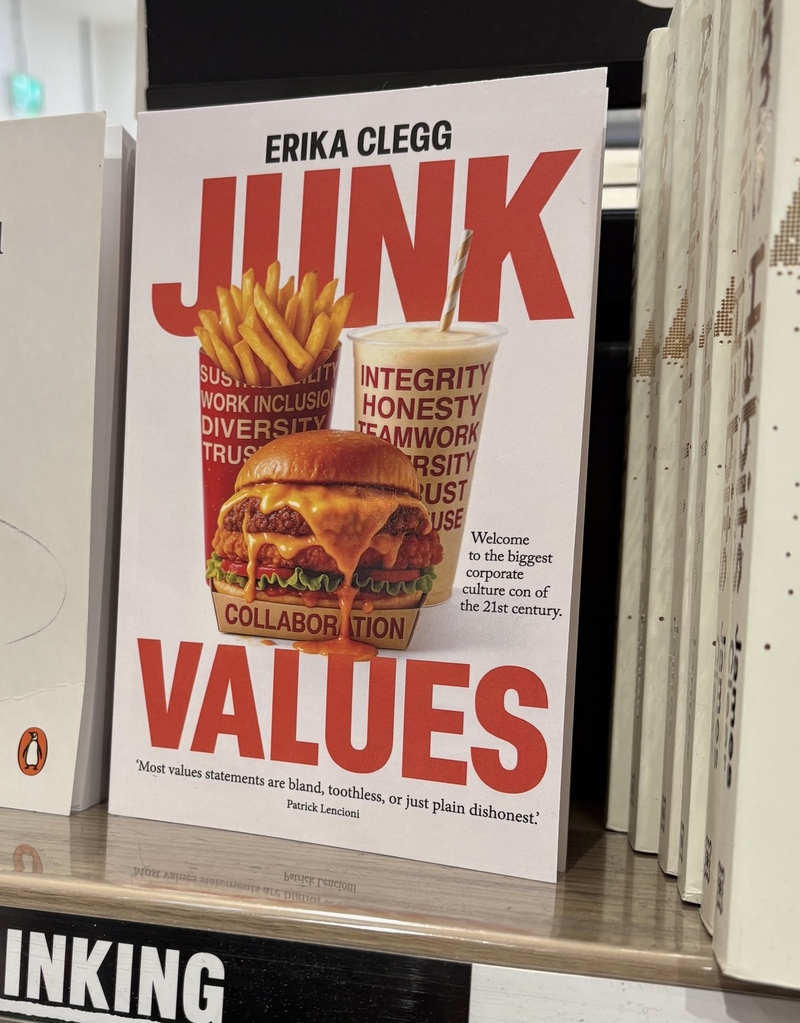
Junk Food is widely available, a quick thing to grab. Wherever you are in the world, a branded burger will be the same. You know what to expect, but its positive impact, if any, is brief and before long you’re hungry again. And over time it’s actively bad for you. Same with Junk Values. They’re hastily-chosen, ubiquitous and damaging.

There are three ways you can spot a Junk Value.
Firstly, they often come from a list of standard words: collaboration, integrity, teamwork, diversity, respect and so on. You know them already because you’ve seen them countless times and quite possibly raised a cynical eyebrow as you did so.
Secondly, they’re not lived. Even if a values set is well phrased, using the language people actually use and based on deep understanding of the organisation, if they don’t come to the fore in behaviours they’re junk. That means that inevitably you will say one thing and do another, which destroys trust.
Finally, they are not true. This doesn’t always come from bad intent. Often the senior team is trying to find ways to bridge a generation gap in their people, but in doing so fall into the trap of saying what they think people want to hear. I’m afraid this will be smoked out pretty quickly.
But if you really dig to understand, go to uncomfortable places, consider what you’re like when you’re at your best, focus on your reasons for wanting to make better choices – then you will come to understand what really matters to you. That applies just as much to organisations as to people.
And when you have got to grips with that, it helps to sum them up in the kind of language you find easy to work with, words and phrases that really mean something to you, and to contextualise them for different people and different situations.
Like slow food, slow values take time to get to. They take effort and can even be challenging. They are of place, of people, grounded in what’s real and what matters. They are interesting, and may be off-putting for some; they’re memorable and very useful when you need to make a hard decision.
My own values are to bring positive energy, know what matters, make the effort and leave things better. Amongst them you will see that different values are useful at different times. I know that when I am in doubt at least one of these phrases will help me to find an answer that I can trust, even if it’s difficult. They feed into my purpose, which is to prosper and cause others to prosper, and my core belief, which is that everything good should flourish.
My first experience of using values in a business was my own. It had grown too fast and become unwieldy. I was struggling to manage it well. Identifying our values and deploying them everywhere in the business meant we emerged with a better, more united team, clients for whom we could make a genuine difference and who respected us, suppliers who delivered on our promises.
Within 18 months of introducing them our headcount had halved, and we had walked away from external partnerships that no longer worked for us. And from then on in, we grew with reference to our values. The progression from that point eventually led to a management buy out by the senior leadership team: two of whom had joined us straight from university and grown in their roles. It was the perfect conclusion.
Since that time I have had the great privilege to work with organisations and people who understand the value of this insight, and have trusted me and the process I follow to help them uncover and work with their principles. It results, almost without exception, in a transformation. And in every case that transformation has been necessary to respond to and thrive in new circumstances.
Junk Values gives its readers the ability to follow my process themselves. It contains my models for understanding organisational and personal values, and the tools needed to build them into functioning behaviours and decisions. These processes are accompanied by theory and anecdotes, by personal stories and clear explanations of what, why and how this stuff matters so much.
It’s designed to be a quick read for people with limited time, with nippy dialogue and a clear logic from start to end. Whilst aimed at people in leadership roles, my intent is that anyone who picks it up will find at least one thing that they can use in their own lives and work.
Writing Junk Values helped me to clarify in my own mind exactly why this work is so important. Of course not everyone’s going to buy into it, and that’s fine. But if more people genuinely understand and benefit from this, then it’s been worth it.
Oh, and I’ll let you into a little secret … that personal stuff at the beginning? I was very uncomfortable about making some of it public. But I knew that it explains why lived principles are of such fundamental importance to me, and that to have left it out would have left out a vital part of the puzzle. Luckily most people have been kind, and I abide by my decision – which, of course, I made guided by my values.

Erika Clegg and her husband founded the brand communications agency, Spring, shortly after their wedding in 2005. They grew it into a national and international player – albeit one based in the seaside market town of Southwold – before its senior leadership team took the reins in 2022.
During that time, Erika also sat on the board of the Design Business Association, the national voice for design effectiveness, and on various regional arts boards.
She has lived happily on the Suffolk Coast for many years having spent her twenties in London. Much of the time she can be found in trains, planes or her bright yellow car, bouncing between assignments. Fuelled, motivated, and occasionally exasperated by values, she has devoted her recent career to helping people and organisations distinguish between the junk and the good stuff.
She helps them to pinpoint their purpose, direction, and principles with absolute clarity and relishes seeing the benefits unfold as this turns into action and results.
Beyond work, she is a wife, mum and stepmum, with a lively household that includes dogs, cats and a constant flow of family and friends. A keen Peloton rider, she thrives on challenges and is always up to something new, from planning her first novel to tackling long-distance walks for charity. Erika is honoured to serve as a Deputy Lieutenant of Suffolk, with a focus on supporting the RNLI, championing the arts, and strengthening community life.