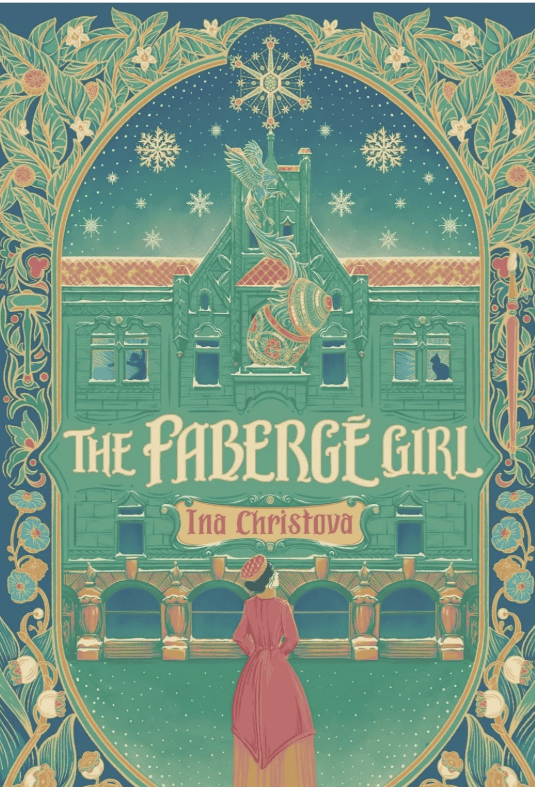
The Fabergé Girl is set during a time that has always fascinated me – namely the silver age of St Petersburg art and culture, just before the revolution that was to change the country forever. It is about Alma – the only female artisan in the House of Fabergé who has the gift or curse of turning her emotions into jewels. The novel explores not just Alma’s journey as an artisan in the renowned workshop but is also about her doomed love story with the peasant-turned-revolutionary Ivan. Alma needs to make a choice between two different ways of life, ways of viewing the world and art.
A Legacy of Stories and Shadows
One of the main issues I wanted to explore is whether art can exist in its own right or it is always to be seen in the context of the society that produced it. For example, Fabergé’s creations are beautiful artworks in themselves but can be seen as obscenely ostentatious during a time of extreme austerity. The other important theme is about what happens to a society that loses its right to self-expression. The revolution gave rise to a highly politicized art that melted the individual into a mass. The Bolsheviks used art as a political tool and obliterated anything that was too closely tied to the previous tsarist regime or not corresponding to their views.
I grew up with stories about Fabergé eggs and the history & folklore of the region. While most of my family is Bulgarian and I was born in Bulgaria, my grandmother was half Ukrainian, half Russian. She had fled the wars at the age of 16 and found a home in Bulgaria. She told my father and grandfather all these fascinating stories that were then passed down to me, along with her family’s collection of fairy tale books. I sadly never met her as she passed away just before I was born but all her stories took such a root in my imagination that she was present in my life in some ethereal way, driven by story.
From Romance to Revolution

I had already written the book and worked on it with my agent by the time I visited the most recent V&A Fabergé exhibition. But it covered very similar themes. Its very tagline: Romance to Revolution pretty much encapsulates what this book is about. The final room of the exhibition showcased some of the most beautiful eggs, each set in a special box and lighting that really presented them as those almost Atlantis-like artifacts from a time and place that no longer exists in the way it did back then. The exhibition featured the full Fabergé catalogue though – not just the eggs but also the flower studies, the animal figurines, the cigarette cases, representing the full Fabergé oeuvre. Many people just know about the eggs but there is so much more. The exhibition showcased a number of Alma Pihl pieces too. It was incredible to see the Winter Egg in person and it really is like a piece of winter in art form with its delicate crystal shell, covered in frost. The icicle pendants were part of the exhibition too. It was amazing to witness all of these pieces that are in the novel itself first-hand. It helped me to finesse some of my descriptions and also to see for myself yet again that all these pieces have something so magical about them. I felt like I was in an enchanted world and this is the feeling I have tried to convey through the novel also.
I wrote the novel before the atrocities that were committed by Russia. Even back then, I was very much thinking about the highly contradictory nature of the Russian soul. I had grown up with folklore and fairy tales from this country via my late grandmother’s books. Yet, I also witnessed the repression Bulgarians were suffering from because of the Communist regime, which was imposed on them by their Russian ‘brothers’, as they were called. Even though the regime collapsed when I was two years old, I could still see and very much feel the shadow of repression every day. People of my parents’ generation were scared to speak their minds and be independent for fear of punishment.
The time I am writing about offered an opportunity for change but it was done in such disorganized fashion that it ended up replacing one tyrant – the Tsar with another – the Bolsheviks. It is this balance that has gone from bad to worse in recent years and led to what we are seeing today. In my novel, I wanted to look at a nostalgic time when things could have taken a different path.
By Ina Christova
Author Biography

Ina Christova is a Bulgarian writer. When not travelling around the world, she splits her time between London and Oxford. She completed an MA in English and German Literature at the University of Oxford where she was the recipient of the Eleanor Boyle and Kathleen Major prizes for her writing. Ina’s work has been longlisted for the Blue Pencil First Novel Awards, the Mslexia Novel Awards, shortlisted for the Cinnamon Press Literature Award and Adventures in Fiction Award, and it won first prize at the Novel London Literary Competition. Her novel ‘The Fabergé Girl’ was traditionally published by East-West in 2024.